Showing posts with label African-American. Show all posts
Showing posts with label African-American. Show all posts
Sunday, August 02, 2009
The State of Jones, by Sally Jenkins and John Stauffer
This link is also to the Amazon Kindle version, but the book is available in other formats, including audio CD.
This is the story of how one man's desertion from the Confederate Army started one Mississippi county's secession from the Confederacy.
Newton Knight was one of many white farmers who was forcibly conscripted to serve in the Confederate Army. His home community, Jones County, had even sent a delegate to the Mississippi convention to vote against secession. This delegate was faced with a lot of pressure to vote for secession, however, and voted to go along with it.
What follows is a long insurgency against the Confederacy, who conscripted the unwilling, took their crops and their livestock, and left a bitter, poor, hungry populace behind. They were further abused by the Confederate enforcers who kept taxing them, which made it easier for Newton Knight and his cohorts to hide out and conduct guerrilla skirmishes against them.
Knight and his band of rebels hid out in the same swamps as runaway slaves, who helped them survive in the same inhospitable wilderness. Knight became more sympathetic with the oppressed blacks than he had already been, and eventually married a former slave woman and had a large family with her.
After the Civil War was officially over, hostilities continued against Knight and his relatives and friends for many years. He long feared assassination, and that was not without reason. Mississippi was just too far away from Washington to get much help, and President Grant was too willing to let the locals work it out. Unfortunately, Knight's race-mixing had cost him a lot of friends, and even family members had begun to change their last name to avoid the association.
It was a long, hard, bitter life for a man who just wanted to be left alone. For all practical purposes he had chosen to become a black man in Mississippi, which was a form of race treason in the Jim Crow South.
This book is a gem and easily gets 4 stars.

Satchel: The Life and TImes of an American Legend
Warning! The link to this book is in the only format that Amazon has available: the Kindle. The Kindle is an electronic book reading device that can download digital material without a computer. It has a cellular modem inside and can "phone" into Amazon wirelessly and download the books directly to the device. If you are interested in purchasing or are even thinking about it, I will link the device in the sidebar.
This audio book was read by Dominic Hoffman, and was 13 hours and 37 minutes long. I obtained it for free from my public library and their vendor, Overdrive Audio.
Satchel Paige began playing pro baseball in the old Negro Leagues back in the 1920s. He was only 18 and had just spent 6 years in a reform school where he got some coaching from a man who worked for the institution. He was a success almost immediately, and had a long and profitable career playing for many teams, including the ad hoc barnstorming teams that often included white major leaguers in the off season. This is where we get an idea of just how good Satchel Paige really was, and Larry Tye's long overdue report on the career of one of baseball's most enduring legends makes a compelling case that he may have been one of the greatest pitchers of all time.
This story is also of Satchel, the man, who made a lot of money in baseball and was as bad at managing it as anyone who has ever played any game professionally. He loved to play ball, and would have played for the rest of his life if he could. He depended on it, since he spent money like the paydays would go on forever.
It's also a story of the times he lived in, and how he contributed to the slow awakening racial equality in America. Satchel had played the roll of the amiable Negro for so long that it wasn't until he had been inducted into the Baseball Hall of Fame in 1971 that he began to sound off about racial unfairness and how he had been mistreated by those who ran the game he loved.
I gave this book 4 stars for its thoroughness and the fascinating topic of the man whose career I was too young to watch.
Monday, February 04, 2008
One Mississippi, by Mark Childress
 This audiobook was obtained from NetLibrary.com, through the Alachua County Public Library. It was 13 hours and 17 minutes long and was narrated by Jeff Woodman.
Daniel Musgrove gets to start his life over in Mississippi after his father is transferred to a new territory. Changing high schools is bad enough, but downgrading from Indiana to Mississippi is excruciating. But then he finds a friend, a local outcast named Tim Cousins.
It's 1973, and their high school is about to elect its first black prom queen. It's also the night that Tim and Daniel take a couple of girls to the prom, and Daniel gets his first kiss. After bringing their dates home, they accidentally hit the new queen, who was riding home on her bicycle. They flee in terror, come back to see that their nemesis, a popular jock and bully, is getting busted for it after stopping to see if she is alright. They let him hang, and when she comes to, she has a colorblind brand of amnesia: she thinks she is white.
The lunacy just keeps coming. This was very, very funny book, but it takes some very, very dark turns. Funny, thought-provoking, sad, disturbing: it gets a star for each, which makes 4 altogether.
Thursday, December 13, 2007
Boom, by Tom Brokaw
 This audiobook was obtained for free from Overdrive Audio through the Alachua County Public Library. It was narrated by Robertson Dean and was 18 hours and 16 minutes long.
I was quite taken with Tom Brokaw's last best seller, "The Greatest Generation". This book is about the baby boomer generation and it's journey through the 60s. Of course, the 60s is defined not by the numerical dates, but by the events that were a part of the 60s narrative. So, it begins with the assassination of JFK and ends with the resignation of Richard Nixon. It is also about people who were pretty much adults at the time. I was only 9 years old during the 1968 Summer of Love, so my own memories of that tumultuous year are undiluted by hormones or hallucinogens. Memories like mine are not represented here.
This is very much a reporter's collection of interviews, which means his subjects do most of the editorializing. And although Tom Brokaw weighs in with his opinions, you also get the recollections and reconsiderations of Gloria Steinem, Arlo Guthrie, Hillary Clinton, Karl Rove, James Taylor, Pat Buchanan, Carla Hills, Tom Hayden, and a lot of people you may have never heard of, but who played a role in the Viet Nam War, the Civil Rights Movement, the Women's Movement, or did a lot of dope.
Whether you miss the 60s or wish they had never happened, there is something here for you. Some of its most famous participants have their criticisms and regrets on both sides of every question. So there really are no definitive answers here, which is appropriate for a book about the generation that made moral relativism and ambivalence our national mood.
It's 4 star entertainment.
Saturday, December 08, 2007
The Tin Roof Blowdown, by James Lee Burke
 This audiobook was obtained from NetLibrary.com, through the Alachua County Library. It was 13 hours and 2 minutes long, and was narrated by Will Patton.
This is my second post-Katrina New Orleans crime novel in the past two weeks. In this story, four young black looters are using a stolen motorboat to get to the abandoned homes of the wealthy, and run into a bit of bad luck. And that's to put it mildly. First, they score a big load of cash, cocaine, and a hand gun from a home that is owned by one of New Orleans' most feared and vindictive crime boss. Second, they decide to steal a gas can from a garage so they can refuel their boat. The garage happens to belong to a man whose daughter was raped by two of the men. A shot rings out in the dark, and one is killed and another paralyzed.
New Iberia Sheriff's Department Detective Dave Robicheaux is mobilized to help in New Orleans, and he is tasked with investigating this crime in a sea of wrongdoing. The crime boss, Sidney Kovick, is also mobilizing his people to find the people who sacked his house and urinated in the spice drawer.
This is one of the better Dave Robicheaux novels in a long time. I had thought it might be time to retire Dave, but I was wrong. I get a little weary of his frequent political asides, but Dave is a flawed man, so one more is not so noticeable if you let yourself get absorbed by the story. And this one is easy to fall into. This one gets 4 stars.
Tuesday, November 20, 2007
The Strong, Silent Type, by C. Kelly Robinson
 This audiobook was obtained free from NetLibrary.com, was 11 hours and 28 minutes long, and was narrated by Ezra Knight and Lizzie Cooper Davis.
Deacon Davis is a former Pittsburgh Steeler and son of a late, great civil right leader. He is politically active as an organizer and speech writer, but he is also a stutterer. After a particularly bad performance on a TV interview, the organization he has been working for gives him the pink slip, and he is persuaded to take part in a speech therapy experiment that will take several weeks of intensive rehabilitation at a college facility.
Davis' life is already pretty complicated. He has a daughter by one woman who is the daughter of a crime syndicate kingpin. He has a son by another woman. That boy is 13 and in trouble at school for groping a female classmate. He also has a black sheep brother who has had cocaine issues. He is still investigating their father's death and is the last person on earth who still thinks it was murder. Add to this the speech therapist that Deacon has a sexual relationship with during his rehab, and this turns into a pretty depressing stereotype festival.
As a voyeuristic soap opera, it's worth 2 stars if you like that kind of thing.
Monday, July 30, 2007
Cooked: From the Streets to the Stove, From Cocaine to Foie Gras by Jeff Henderson
 This audiobook came free from Netlibrary.com, was 8 hours and 3 minutes long, and was read by the author.
This was a pretty entertaining book that chronicles the life of a young black man's career track from petty criminal to crack merchant to prison pot scrubber to high class chef in Las Vegas. It's also a disturbing look at some of the warts of African-American culture. I don't think Jeff Henderson was trying to portray the black church as one with a willful blindness toward its drug kingpins, or if he knows that there is an uneasy truce between vice and virtue that is bought with the money that comes to the offering plates. I suppose I am bringing this up because of my own sensitivity to the incongruities in many white churches. There are a lot of things to be embarrassed about, unless you are willing to do the noble thing and confront them.
What Henderson nails down in this story is that redemption is not just about being given a pass the next time around. It is about doing the work, paying the price, and overcoming the same obstacles everyone faces, black or white or Latino, to be a top chef and commanding top dollar. Management skills are as important as your sauces, and he learned his the hard way. He was not an overnight success.
This gets 4 stars.
Tuesday, June 19, 2007
Freakonomics, by Steven D. Levitt and Stephen J. Dubner
 This audio book came from the Alachua County Public Library on 6 CDs, was 7 hours long, and was narrated by Stephen J. Dubner.
I was on a long waiting list to get this book from the library. I have been hearing about it for a long time.
It's Steven Levitt's research that is the basis of this book. The sub-title refers to him as a rogue economist, but I think that only means he talks about everyday things instead of the consumer price index and gross domestic product. This book seems to be a mesh of psychology and economics: a study of incentives and how they motivate people in the real world. It seeks to answer questions like: How has legalized abortion affected crime rates? And, If there is so much money in dealing drugs, why do so many drug dealers live at home with their moms?
This book's completely rational, utilitarian approach to human behavior in the marketplace delivers a lot of surprises. It is completely amoral, so it will unsettle people who have the strongest moral compass. But it will be fair in that it disturbs people on both sides of a moral issue. After all, if you just go by the numbers, you can come to some pretty dehumanizing conclusions.
It wasn't a long book, so that means it got to the point. It waded into geek speak only long enough to establish its credentials. It was highly entertaining and thought-provoking, and worth 4 stars any day.
Friday, June 15, 2007
Waiting `Til the Midnight Hour, by Peniel E. Joseph
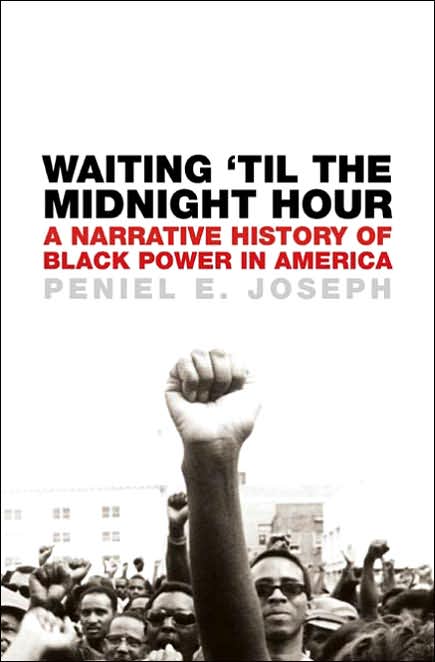 This audio book was a free download from NetLibrary.com, was 13 hours long, and was narrated by Beresford Bennett.
As a white kid growing up in Upstate NY during the 60s, that names of Stokely Carmichael, Eldridge Cleaver, "Rap" Brown, and Angela Davis were not familiar to me. Even Malcolm X would have drawn a blank in a neighborhood with no unrest and few blacks. And those who did live among us were fully integrated into the neighborhood. I even had an African American history class in the 6th grade, but the aforementioned pioneers of the Black Power movement were not yet history. They were the news. At least they were in other parts of America.
This book was fascinating, enlightening, and disheartening. It was fascinating because it fleshed out the players in America's Civil Rights movement. It was enlightening because it was a very human story anyone could identify with. It was disheartening because every problem is viewed through the lens of the black/white struggle. And not every problem in the black community is the fault of white people.
One of the things that sticks out here is that all the leaders were so incredibly young. By the time he was 29, Stokely Carmichael had met Ho Chi Mihn and Fidel Castro. He had been all over the world, including China, and was a world famous icon of revolutionary struggle. What do you really know by the time you are 29? Consequently, some of the players no longer believe what they did when they were getting everyone else on board.
This is a terrific story of people insisting on being heard. It worked, warts and all. There are characters who will surprise you and impress you and annoy you. This was an engrossing story and worth every one of 4 stars.
Monday, April 30, 2007
Thieves' Paradise, by Eric Jerome Dickey
 This book also comes from the Alachua County Public Library, was on 12 CDs, 12 hours and 30 minutes long, and narrated by Bill Andrew Quinn. I plucked this one off the shelf because I recognized the author's name, and I knew I had never read him.
At 25 years old, Dante Brown has no family, no job, and plenty of baggage. He did a long stretch in juvenile hall as a teenager after he pulled a gun on his abusive father, who was also a police officer. Both parents are now dead, and his luck has been more down than up. While waiting for a new employer to call him, Dante falls back on the safety net offered by Scamz, a slick con-man who provides short term employment for the entire black community at one time or another. At least it seems that way in this story.
I found this story rather disturbing because it looks like every black person with a legitimate job only serves as an undercover asset for Scamz: stealing credit card information, acting as a courier for stolen plastic, assisting in real-estate swindles. And every woman is a snake. They are either trying to tag some innocent dupe to be the daddy of someone else's child, stepping out on the dupe, or doing anything for money. If I had written this, I could expect to see my face on Fox News right next to Reverend Al's talking head.
If this is just an "authentic novel about black culture", it's a serious downer. I find it hard to believe that every African-American is on retainer for an ad hoc firm of grifters. I don't know anyone like this. Or maybe I do and I just don't know it.
A very sad story well-written, for which I cannot forgive its infectious negativity. It gets 2 ambivalent stars.
Wednesday, April 25, 2007
Def Jam, Inc., by Stacey Gueraseva
 This book was obtained from the Alachua Public Library, was on 9 CDs, and was published in 2005. It was narrated by Kevin R. Free.
Yes, this is the story of Hip-Hop, as it was nurtured by a record company started by a 19 year-old white Jewish college student and a black rap impresario. Rick Rubin and Russell Simmons were out promoting the urban beats before radio would have them, so they took the music of young artists in the embryonic hip-hop movement and brought it straight to the streets.
Part music history, part guerrilla marketing primer, this is a fascinating look at a music genre in which I have previously had little interest. It still doesn't speak to me, although it was hard to listen to this story without beginning to care about the players.
Hip-hop, it appears, was a multi-racial movement from it's beginning. And Def Jam promoted black and white artists. It's all-time biggest star, as I learned later, was actually the Beastie Boys, which I always thought was a punk rock group. They were frequently eclipsed by other acts, like LL Cool J, Run DMC, Public Enemy, and other black stars, but for sheer longevity and raw numbers, the Beasties have outsold them all.
The violence associated with black rappers is only a small part of this story, as was the east-west rivalry that sometimes lead to bloodshed. As an outcast industry, hip-hop was originally shunned by black radio stations that were run by Motown era conservatives that wrinkled their noses at the new upstarts. If they got airplay at all, it was usually late at night. This outsider position made it a magnet for outlaw elements.
This was an eye-opener, and I did enjoy it, although I thought it ended a bit abruptly. I give it 3 stars.
Sunday, March 18, 2007
The Summer We Got Saved, by Pat Cunningham Devoto
 This audiobook was free from NetLibrary.com, was 12 hours and 53 minutes long, and was narrated by Katie Firth.
Tina and her younger sister, Tab, are part of a southern family in the 1960's that is collectively ambivalent about its connection with the founding of the Ku Klux Klan. The older members are proud and defensive of their heritage. Tab and Tina are more concerned about makeup and the pecking order at the malt shop. The girls' father, Charles, is hoping the coming changes will happen smoothly and gradually. The girls' aunt Eugenia is a flaming civil rights activist, and she is here on her annual, excruciating family visit.
Eugenia proposes to take the girls to visit some other distant relative for a week, and the other adults are relieved to let her go. What no one realizes is that Eugenia actually plans on taking the girls to the Highlander Folk School, a training camp for union and civil rights activists since 1932.
A parallel story involves Maudie, a childhood friend of the girls who went to Tuskegee Institute for polio rehabilitation, and is now running a voter education program at a black Missionary Baptist Church. She is not entirely welcome there. Blacks in the community don't all get it, and see this activism as a nuisance that will only draw fire from the local rednecks. It's an uphill struggle for Maudie, who fits in with no group. She is the "crippled girl" and is treated with derision by the young "cotton girls" who live to drink and carouse.
Tab's clueless innocence isn't quite ruined by what she has learned by participating in a sit-in at a Woolworth's counter. After all, she gets to go home from all of this. But she will never simply parrot the family lore any more. It's not that she thinks it isn't real. She has simply encountered something more real.
I gravitate toward stories like these because I lived through the Civil Rights Era on television. It simply was not an issue in my town, and in my school. I never went to a segregated school. My Boy Scout troop was integrated, but we never thought about it as such. I had an African-American History class in the 6th grade (1969), and it was a real immersion into the incredible injustices that were perpetrated in the past. It made me wonder if people in the South were actually human. Now I live here, and sometimes feel like I am not in on the secrets. I think I may have gotten a few clues from this engaging story. It gets 4 stars from me.
Friday, February 02, 2007
The Amalgamation Polka, by Stephen Wright
 This book came from NetLibrary, was 11 hours and 46 minutes long, and was narrated by Michael Emerson.
This book was much better than its title, which is a derivative of one of the derogatory names for Abolitionists of the mid-19th century: Amalgamators.
Set before and during the American Civil War, this is a coming of age tale of both Liberty Fish and his mother, Roxana Maury. She grew up on a plantation surrounded, and nourished by, the institution of slavery in all its brutality. He grew up in a fiercely abolitionist family in Upstate New York.
Roxana meets Thatcher Fish in Saratoga, New York, where the female Maury's have gone on holiday after a huge family blowout on the morality of their existence. She bolts from the family after a final argument with her mother the same way she came into the world, naked. Wrapped only in a bed sheet, she seeks out the young man she has just met at their hotel, who shares her political viewpoint.
Liberty Fish, their son, grows up as a kind of abolitionist Huck Finn. His family's home is a stop on the Underground Railroad, and his life is full of odd characters. When the Civil War begins, he enlists, and begins a journey to his mother's ancestral home in South Carolina, where he confronts his slaver grandfather, who has morphed grotesquely into the Joseph Mengele of the South; performing experiments on his black servants in efforts to make them white.
This novel was both funny and revolting, and never boring. The prose is delightful to listen to. It transports you to a time when people were more literate, long before we were only computer literate. This is a 4 star book.
Monday, January 22, 2007
Her Own Place, by Dori Sanders
 This is from Net Library, is 6:33:12 long, and is narrated by Kim Staunton. It was published in 1993.
Taking a rest from crime and history, I got this because I was looking for a literary respite. This was a good place to find it. Dori Sanders lives the life she writes about: growing up on a farm in South Carolina in the same ara as her slave ancestors.
This is not a book that dwells on the tragedy of racism but on the triumph of an ordinary life lived well, with all the ups and downs of the people of her times. It is easy for any person to identify with someone who is not scanning the horizon for someone to blame; not even the man who abandons her main character, Mae Lee, with 5 children after World War Two.
Her Own Place begins at the start of the war and moves briskly, yet without missing the details. This is quite an accomplishment, and it marks Ms. Sanders as a great storyteller. I rambles through the civil rights era, Viet-Nam, and desegregation while seldom leaving the farm she bought as a young wife with the money she earned at a munitions plant.
I really enjoyed this and will look for books by this author again when I am looking for a real escape from the tensions of my life. 4 stars.
Subscribe to:
Posts (Atom)


