Showing posts with label history. Show all posts
Showing posts with label history. Show all posts
Monday, November 30, 2009
Cheap, by Ellen Ruppell Shell
This audiobook was obtained form Overdrive Audio through the Alachua County Public Library. It was 11 hours and 33 minutes long, and was narrated by Lorna Raver.
It is very fashionable to beat up on capitalism at this time. This book makes sure that LOW prices also get their day in the stocks. The best part of this book is the history of discounting that is therein. The worst are the central planning solutions alluded to by the author.
As a self-employed person who has had his own business for almost 30 years, I found Ms. Shell's ivory tower cluelessness grating. Her bleeding heart sorrow for the plight of low wage workers could have been mitigated by the revelation that local governments have raised the barrier of entry to small business startups through zoning regulations that would have prevented New York's garment trade from ever getting off the ground. Only the rich can go into many businesses precisely because of top down planning. Save your time. One star for its overbearing politics.

Sunday, August 02, 2009
The State of Jones, by Sally Jenkins and John Stauffer
This link is also to the Amazon Kindle version, but the book is available in other formats, including audio CD.
This is the story of how one man's desertion from the Confederate Army started one Mississippi county's secession from the Confederacy.
Newton Knight was one of many white farmers who was forcibly conscripted to serve in the Confederate Army. His home community, Jones County, had even sent a delegate to the Mississippi convention to vote against secession. This delegate was faced with a lot of pressure to vote for secession, however, and voted to go along with it.
What follows is a long insurgency against the Confederacy, who conscripted the unwilling, took their crops and their livestock, and left a bitter, poor, hungry populace behind. They were further abused by the Confederate enforcers who kept taxing them, which made it easier for Newton Knight and his cohorts to hide out and conduct guerrilla skirmishes against them.
Knight and his band of rebels hid out in the same swamps as runaway slaves, who helped them survive in the same inhospitable wilderness. Knight became more sympathetic with the oppressed blacks than he had already been, and eventually married a former slave woman and had a large family with her.
After the Civil War was officially over, hostilities continued against Knight and his relatives and friends for many years. He long feared assassination, and that was not without reason. Mississippi was just too far away from Washington to get much help, and President Grant was too willing to let the locals work it out. Unfortunately, Knight's race-mixing had cost him a lot of friends, and even family members had begun to change their last name to avoid the association.
It was a long, hard, bitter life for a man who just wanted to be left alone. For all practical purposes he had chosen to become a black man in Mississippi, which was a form of race treason in the Jim Crow South.
This book is a gem and easily gets 4 stars.
Satchel: The Life and TImes of an American Legend
Warning! The link to this book is in the only format that Amazon has available: the Kindle. The Kindle is an electronic book reading device that can download digital material without a computer. It has a cellular modem inside and can "phone" into Amazon wirelessly and download the books directly to the device. If you are interested in purchasing or are even thinking about it, I will link the device in the sidebar.
This audio book was read by Dominic Hoffman, and was 13 hours and 37 minutes long. I obtained it for free from my public library and their vendor, Overdrive Audio.
Satchel Paige began playing pro baseball in the old Negro Leagues back in the 1920s. He was only 18 and had just spent 6 years in a reform school where he got some coaching from a man who worked for the institution. He was a success almost immediately, and had a long and profitable career playing for many teams, including the ad hoc barnstorming teams that often included white major leaguers in the off season. This is where we get an idea of just how good Satchel Paige really was, and Larry Tye's long overdue report on the career of one of baseball's most enduring legends makes a compelling case that he may have been one of the greatest pitchers of all time.
This story is also of Satchel, the man, who made a lot of money in baseball and was as bad at managing it as anyone who has ever played any game professionally. He loved to play ball, and would have played for the rest of his life if he could. He depended on it, since he spent money like the paydays would go on forever.
It's also a story of the times he lived in, and how he contributed to the slow awakening racial equality in America. Satchel had played the roll of the amiable Negro for so long that it wasn't until he had been inducted into the Baseball Hall of Fame in 1971 that he began to sound off about racial unfairness and how he had been mistreated by those who ran the game he loved.
I gave this book 4 stars for its thoroughness and the fascinating topic of the man whose career I was too young to watch.
Saturday, June 13, 2009
The Fall of Che Guevara, by Henry Butterfield Ryan
This audiobook was 7 hours and 19 minutes long, and was narrated by George McGonagle.
Before I got this audiobook, I knew almost nothing about Che Guevara, although I could pick his image out of a lineup thanks to the iconic image that has appeared on a million or so T-shirts. So, this book was a voyage of discovery for me.
The author tells Che's story as a reporter would gie you the background on the subject, but then just get straight to the facts. He uses a lot of documents from the CIA and other government sources, going as far as to get them declassified himself. What emerges is the recounting of a frustrated revolutionary who was pushing the envelope on revolutionary theory to a point that it got him killed.
Che blundered when he thought he could get a revolution started in Bolivia by inserting a little over 50 commandos out in the jungles to stir up the peasants. The peasants were not particularly unhappy with their government, being far removed from it, and did not like the armed iealists who came to stir them up. They ended up ratting him out to the government forces who were looking for him.
To Che's admirers, this is a controversial subject. Some think Castro had him killed. Some think the CIA did him in. The evidence in this book has enough holes to leave your prejudices intact, but it all seems like a bad judgment call to me. I give it four stars for being informative, clear, and not taking unnecessary time.
Thursday, June 04, 2009
Charlie Wilson's War, by George Crile
This audiobook was 20 hours and 27 minutes long, and was narrated by Christopher Lane.
I never saw the movie, so I have no idea how the book and the movie are different. I always trust the book.
This is the story of how a Democrat Congressman from Texas took up the cause of the Afghan people after discovering how the army of the Soviet Union was wiping out all resistance to their invasion. As a member of the Appropriations Subcommittee on Defense, he was able to move millions, and eventually, billions of dollars to aid the Afghan insurgents who were still fighting with WW1 Enfield Rifles against helicopter gunships and tanks.
Charlie Wilson was a liberal who voted for civil rights, abortion rights, and all manner of liberal causes, but who was also a rabid anti-communist who wanted America avenged for the Viet Nam War. The Soviets had helped the Vietnamese insurgents bleed America dry, and he wanted to give it right back to them through proxies in Afghanistan.
This is a very instructive tale about how politics actually works at the Federal level, showing how unholy alliances really work. Relationships really do seem to trump ideologies, as Charlie Wilson becomes friends with Fundamentalist Muslim leaders who look the other way at his womanizing, boozing lifestyle while he bankroles their Jihads. In Congress, those who want to fight communists in Central America with Iranian money are prosecuted while American taxpayer dollars are matched by Saudi contibutions to fight communists on the other side of the world with the blessing of the same Congress. It seems that if a liberal want so run a secret war, it's OK. But if conservatives want to do it, it's unconscienable.
Political skill transcends morality even as American politicians convince themselves that they are doing the right thing to fund a primiative militia that has no limits on the atrocities they are willing to perform on captured Soviet soldiers. Eventually, these same Afghan militias will come back to haunt us in ways the Latin American Contras never did.
This is a must read for anyone who cannot understand the holes in the news. 4 stars!
Thursday, May 21, 2009
The Coldest Winter: America and the Korean War, by David Halberstam
This audiobook was 33 hours and 42 minutes long, and was narrated by Scott Brick.
This was David Halberstam's last completed work before he died in 2007. It is the usual top notch piece of 20th century history for which he was famous.
America and its military leaders thought that the atomic bomb was the end of conventional warfare. President Truman was looking to trim the defense budget to under $10 Billion, the American people just wanted their boys to come home, and the rest of the world was still at the brink of war. The US had gone from victory in Europe and the Pacific to total military unpreparedness in only 5 years. It set the stage for a deadly learning curve in Korea.
Much of this book concerns the mishandling of military intelligence by General Douglas MacArthur and his staff. MacArthur's best days were behind him and he didn't know it. He also had a lot of help from President Truman's domestic adversaries, mostly Republicans who made up the China Lobby. They were as hot for a confrontation with China as MacArthur was, and this desire for turning back the Communists in China nearly brought us into World War 3.
There are lots of stories from the actual conflict as well as the inside dirt on American politics during the McCarthy era. A fascinating book, even if it ran a bit long. I give it 3 stars.
Thursday, May 07, 2009
Leni: The life and work of Leni Riefenstahl, by Steven Bach
This audio book was read by Henrietta Tiefenthaler, and was 14 hours and 26 minutes long.
I was already aware of who Leni Riefenstahl was because I had seen a story about her on television when I was a teenager. She was famous for being the Third Reich's film maker. She was a talented director who made what has been called the best documentary ever by her harshest critic. And until 2003, she was still alive, and still unrepentant about her work for Hitler.
Born in 1902, she was the daughter of a successful plumber and a woman who encouraged her dreams of being a dancer. She began her career in the middle of the silent film era, and she gradually evolved from dancer to romantic adventure to an interest in directing her own films. After reading Adolf Hitler's Mein Kampf on a train, she decided she had to meet him. Since she was a minor film starlet that Hitler admired, she got her wish.
Leni Riefenstahl leveraged her relationship with Hitler, her talent and ambition, and the vacuum left by the German film industry's expulsion of the Jews, into an opportunity to be the Reich's official filmographer. Her documentaries of Nazi rallies and the 1936 Olympics in Berlin made her internationally famous, and after the WW2, almost universally despised.
If this book were only about her work for Hitler, it would probably be interesting enough. But hers was the story that refused to die. After avoiding prison, and being labeled as only a "fellow traveler" in the spectrum of guilt, she thought she was off the hook and could continue with her career. But multitudes had been witnesses to her work, so there was always someone to remind the world that she was an unrepentant Nazi who brazenly lied about her past.
This book gets 4 stars, but Leni herself rates one flashbulb.
Friday, December 28, 2007
East to the Dawn, by Susan Butler
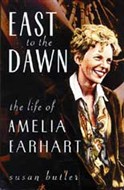 This audiobook was obtained from Overdrive Audio for free through the Alachua County Public Library. It was 18 hours and 43 minutes long, and was narrated by Anna Fields.
This is the story that goes beyond the legend, and beyond the comfort zone of many who may have admired her. She was a brave and daring aviator, an outspoken feminist, and a bit of a head case.
Back in the early days of aviation, there was very little regulation and it was one of the places where women had the most freedom. Amelia Earhart learned to fly from another woman pioneer, Neta Snook. Amelia had learned about mechanics from her days as an ambulance driver during WWI, when you also had to know how to fix your vehicle. And it's a good thing, because early airplanes needed to be fixed often.
Flying was just a hobby for her for several years. She was earning her living as a social worker. Other women were looking to be the first woman to cross the Atlantic after Charles Lindbergh had become an international celebrity for doing so. American socialite named Amy Guest, who was also a pilot, had wanted to do it, but her family made her back off. She still wanted the project to go on, so she offered to back someone else that she would recruit who would have the right image and do women proud.
Amelia Earhart got the call from a promoter who had heard of her, and asked if she wanted to fly across the Atlantic. Amelia jumped at it, and it made her fortune. She used it as a springboard for a speaking and publishing career.
Amelia eventually married her publisher, who had been married when they first began working together. She didn't want to be tied to one man, however, and actually requested that theirs would be an open marriage.
This book chronicles Amelia's life from early childhood to her disappearance over the Pacific in 1937. Very little is left unexplored, and it done in a sympathetic manner. It's hard to put down, and full of interesting information. That's what makes it a four star book for me.
Thursday, December 13, 2007
Boom, by Tom Brokaw
 This audiobook was obtained for free from Overdrive Audio through the Alachua County Public Library. It was narrated by Robertson Dean and was 18 hours and 16 minutes long.
I was quite taken with Tom Brokaw's last best seller, "The Greatest Generation". This book is about the baby boomer generation and it's journey through the 60s. Of course, the 60s is defined not by the numerical dates, but by the events that were a part of the 60s narrative. So, it begins with the assassination of JFK and ends with the resignation of Richard Nixon. It is also about people who were pretty much adults at the time. I was only 9 years old during the 1968 Summer of Love, so my own memories of that tumultuous year are undiluted by hormones or hallucinogens. Memories like mine are not represented here.
This is very much a reporter's collection of interviews, which means his subjects do most of the editorializing. And although Tom Brokaw weighs in with his opinions, you also get the recollections and reconsiderations of Gloria Steinem, Arlo Guthrie, Hillary Clinton, Karl Rove, James Taylor, Pat Buchanan, Carla Hills, Tom Hayden, and a lot of people you may have never heard of, but who played a role in the Viet Nam War, the Civil Rights Movement, the Women's Movement, or did a lot of dope.
Whether you miss the 60s or wish they had never happened, there is something here for you. Some of its most famous participants have their criticisms and regrets on both sides of every question. So there really are no definitive answers here, which is appropriate for a book about the generation that made moral relativism and ambivalence our national mood.
It's 4 star entertainment.
Tuesday, November 27, 2007
Higher, by Neal Bascomb
 This audiobook was obtained for free from NetLibrary.com, was 11 hours and 10 minutes long, and was narrated by Richard M. Davidson.
The 1920s were the perfect time for egos, ambition, idealism, and innovation to thrive. And it was at the very apex of the Roaring 20s, just before the collapse of the stock market, that the modern skyscraper began to flower.
This story is about the men who designed, financed, and built the tallest buildings in the world at the dawn of the Great Depression. Walter Chrysler, the newly minted automobile magnate, was an engineering junkie who played an active roll in designing the Chrysler Building. The architect, William Van Alen, was a highly regarded designer who had acrimoniously split with his business partner, H. Craig Severance. Severance was now building a competing project at 40 Wall Street, and both men were determined to build the tallest building in the world.
This is a more interesting book for all the background on the creation of the technology that allowed buildings to go from the load-bearing masonry construction that limited height, to the steel-cage design, high speed elevators, and improved hydraulics that make it possible to both build and inhabit skyscrapers.
But it's the human story with its attendant drama that takes "Higher" to another level. All of the parties who were involved in these projects had come from humble beginnings, and these buildings were also intended to be monuments to ideas and hope; something that we would do well to grasp in our cynical age. This is a 4 star book.
Saturday, October 20, 2007
River of Doubt, by Candice Millard
 This audiobook was found at the Alachua County Public Library, came on 10 CDs, and was narrated by Paul Michael.
When my customers find out what an audiobook junkie I am, they sometimes make suggestions to me from their own reading. This year, someone told me about "River of Doubt" and I was immediately intrigued because I am a big fan of Teddy Roosevelt. I could not find this title for awhile, and even now it is unavailable at Amazon.com. But one day a search on the library website turned it up, and I put it on reserve. It was waiting for me when I got back from vacation.
This is a wonderful mix of history, biography, and suspenseful adventure. Any one of those descriptions is enough to lure me in, but all three, combined with Theodore Roosevelt risking life and limb in the Amazon jungle as a form of post-election therapy makes this unforgettable. Candice Millard takes you there with research that would rate as overkill if it were about anyone else.
It's both gripping and sad, as it also turns into a father and son examination. TR and his third son, Kermit, near-lethal hardships and acquit themselves admirably. Kermit was very much his father's son when it came to physical endurance and toughness in the midst of calamity. But away from the snake and cannibal infested testing ground, they were two totally different men.
I will avoid the spoilers and say that this is a 4 star delight, whether you are a history buff or and adrenaline junkie.
Thursday, August 23, 2007
Marwan, by Aram Schefrin
 This audiobook came in 32 episodes from Podiobooks.com, was in mp3 format, and is narrated by several unidentified persons.
This is a novel about Marwan al Shehhi, one of the September 11 hijackers. It is a chilling story based on the documented investigation into the terror attacks. I was curious to see how the author, Aram Schefrin, managed to humanize such a monster. Could a complex individual full of misgivings have flown into the 2nd tower of the World Trade Center? Or would he have to be a complete sociopath?
This book was hard to put aside, and the time flew by. "Marwan" was both sad and riveting. Schefrin succeeds at keeping your pity for Marwan separated from your horror of what he has done. And you need to do that to see the next terror attack coming. Marwan was not a "bad seed", but he had many of them sown in his brain. Ideas matter, and you cannot fight them with mere law enforcement.
Monday, August 06, 2007
Adams Vs. Jefferson: (The Tumultuous Election of 1800), by John E. Ferling
 This audiobook was obtained for free from NetLibrary.com, was 11 hours and 33 minutes long, and narrated by Jack Garrett.
You don't know how little you have really been taught about American History until you start reading books on the Founding Fathers. I got the same names and dates drilled into my head year after year with precious little light ever entering that would have helped me understand my country and its system of government.
The Election of 1800 was the first contested election in American history. The Election of 2000 has nothing on this. And the opposing forces come right out of the same molds that popped out our current leaders. The Federalists were the party of law and order and a strong military. They fought to enact the "Alien and Sedition Acts". These were the Patriot Act on steroids. The Republicans (not the same party we know today) was anti-military and in love with the French Revolution, although a bit queasy about the acts of terror. It's funny how little really changes; only the names and places.
This was a gripping and vivid story of the men who guided our nation in its formative years, their feet of clay, and a lot of surprises for people who thought they knew their American History. Well written and well ready by the narrator, Jack Garret; this book is a 4 star champ.
Friday, June 15, 2007
Waiting `Til the Midnight Hour, by Peniel E. Joseph
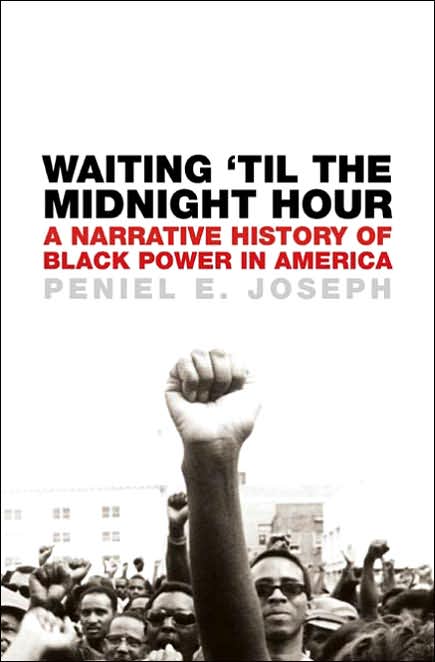 This audio book was a free download from NetLibrary.com, was 13 hours long, and was narrated by Beresford Bennett.
As a white kid growing up in Upstate NY during the 60s, that names of Stokely Carmichael, Eldridge Cleaver, "Rap" Brown, and Angela Davis were not familiar to me. Even Malcolm X would have drawn a blank in a neighborhood with no unrest and few blacks. And those who did live among us were fully integrated into the neighborhood. I even had an African American history class in the 6th grade, but the aforementioned pioneers of the Black Power movement were not yet history. They were the news. At least they were in other parts of America.
This book was fascinating, enlightening, and disheartening. It was fascinating because it fleshed out the players in America's Civil Rights movement. It was enlightening because it was a very human story anyone could identify with. It was disheartening because every problem is viewed through the lens of the black/white struggle. And not every problem in the black community is the fault of white people.
One of the things that sticks out here is that all the leaders were so incredibly young. By the time he was 29, Stokely Carmichael had met Ho Chi Mihn and Fidel Castro. He had been all over the world, including China, and was a world famous icon of revolutionary struggle. What do you really know by the time you are 29? Consequently, some of the players no longer believe what they did when they were getting everyone else on board.
This is a terrific story of people insisting on being heard. It worked, warts and all. There are characters who will surprise you and impress you and annoy you. This was an engrossing story and worth every one of 4 stars.
Sunday, June 03, 2007
Night, by Elie Wiesel
 This audio book was 4 hours and 17 minutes long, including a reading of Wiesel's speech to the Nobel Prize committee in 1986. It was free from NetLibrary.com.
This book was originally published the year I was born, 1958. That was 13 years after Elie Wiesel's liberation from the German death camps at the age of 17.
When I was growing up, all adults still had a fresh remembrance of the monstrous regime that had terrorized the world, and the Holocaust was already a part of the vocabulary. I saw all the movies about Nazi atrocities, and took seriously my duty as a part of humanity to remember what was done to the Jews and other minorities. How I missed this book is a wonder.
This story sets itself apart from the rest of my personal witness of the media's rendition of the Holocaust. Most books and movies focus on the cruel inhumanity of how the Jews were treated. Wiesel's book spends the first half documenting the denial of the Jews as they saw it coming. Yes, there are a couple of voices in the wilderness, but they are usually scorned and despised for their prescience.
This simple account, unadorned by the gratuitous violence of most Holocaust movies, made it easy for me to believe that the average German citizen could have been in the same state of unbelief while this was happening. It is also a grim warning to all of us that neutrality only benefits the oppressor, as Wiesel states in his speech to the Nobel committee. We must take sides in the resistance to dictators. And we must do it early. At least, that's what I came away with. And this gets 4 stars.
Thursday, May 31, 2007
Travels of a T-shirt in the Global Economy, by Pietra Rivoli
 This audio book came free from NetLibrary.com, was 9 hours and 35 minutes long, and was narrated by Eliza Foss.
An economist is both annoyed and inspired by a protest against globalization by impassioned college students. After hearing one of the open-air speakers demand to know if we know were our t-shirts come from, economist and professor Pietra Rivoli goes to a souvenir shop, buys a t-shirt, and begins tracing its origins...and its destiny.
This is one of the most readable and interesting stories of the economic food chain you are likely to come across. It was a real page-turner with a stunning conclusion, that we all should be able to come to on our own: both the sweat shops and the protesters are important ingredients in the global ecosystem.
If you are a rabid free-trader, you must read this! It will alter your view of those naiive kids and their signs. If you are one of those capitalist-hating anti-globalists, you also should read this. If you have an open mind, it will temper your outrage and help you focus your efforts.
From the heavily protected and subsidized cotton fields of West Texas to the wide open, unregulated global recycling market in Africa, your t-shirt and been places and one things. And then it may come back again as it is broken down and respun into new thread!
Warning: there is lots of history in this book about the folly of working too hard to prevent trade. The English woolens industry kept cotton out of its markets for centuries. But regulations got weaker and weaker in the face of the eager public adoption of cooler cotton clothes. The last regulation to die was the one that required that the dead had to be buried in a wool suit!
Great stuff. Four stars. Oughta be a text book in our schools...
Thursday, May 24, 2007
The New Golden Age, by Ravi Batra
 This unabridged audio book came from the Alachua County Public Library on 9 CDs, and was read by Brian Emerson.
If you make enough predictions, you are bound to get some right. Both psychics and economists count on this, and Professor Batra is no different. In fact, Batra was the winner of an Ig Nobel prize in 1993. He was described as a, "shrewd economist and best-selling author of "The Great Depression of 1990" ($17.95) and
"Surviving the Great Depression of 1990" ($18.95), for selling enough copies of his books to single-handedly prevent worldwide economic collapse."
When Batra is not delivering an anti-Bush and Cheney rant, this idealistic Hindu slant on history is actually quite provocative and entertaining. It is mostly an expansion on P.R. Sarkar's theories of social evolution. These theories propose that societies are comprised of 4 social classes: laborers, intellectuals, warriors, and acquisitors (capitalists). The intellectuals, warriors and acquisitors take turns dominating and ruling society as the laborers cast their lots with each group in a predictable progression. The domination of the rich acquisitors always ends in massive corruption, immorality and poverty. The warriors and labor take their country back, establish order, fairness and traditional family. Eventually, they give way to the intellectuals, who are better at governing than conquering. Then they give way to the business people, who are better at expanding opportunity. When not enough people are taking advantage of opportunity, and those who are live like kings, the warriors again ascend to restore justice. At least, that is theme of this book.
It is easy to get caught up in Batra's worldview because he draws on so much history to demonstrate his thesis. And much of that history comes from beyond Western Civilization, which raises the level of fascination. He tells us that there are frequent examples of Golden Ages, which he always assigns to the time after the evil rich are dethroned. Of course, these Golden Ages come on two-edged swords. It is not uncommon for them to have rather puritanical backlashes against pornography, prostitution, and homosexuality. The poor are not just sick of the injustices of the rich. The perversion and vulgarity of the age usually suffers as well. The recent squeeze on talk radio hosts Don Imus and Opie & Anthony were not led by the Religious Right, but by civil libertarians devouring their own kind. Apparently, a lot of people have limits after all.
Like a good economist, who has been burned by his own lack of judgment in the past, Batra demonstrates that there are also escape clauses for the social cycle and all that comes with it. After venting his spleen on Bush and the Iraq War, he actually dares to say that the rest of the world needs to pitch in and help because America has saved the world's bacon before, and that failing to do so could be a big mistake! He even intimates that history may vindicate Bush in the end.
In the last chapter, he also does a little back-pedaling on the meaning of the Golden Age. But I can forgive him because I always grade economists on a curve. In spite of its sometimes puzzling contradictions and omissions, I gave this book 3 stars for having much to offer any discussion on national and international affairs. There is something to offend everyone, and to enlighten as well.
Friday, May 11, 2007
Dark Genius of Wall Street, by Edward Renehan
 This book was obtained for free from NetLibrary.com, was 14 hours and 50 minutes long, and narrated by George Wilson.
This great biography is about one of the players of America's Gilded Age, Jay Gould, King of the Robber Barons.
I don't know if you can really get a grasp of American history without getting to know the players. Jay Gould was the most notorious stock manipulator of the 19th century, and one of the richest men in the world during his lifetime. He began as a teen-aged land surveyor who got stiffed by his employer. From there he began publishing the maps he was stuck with, then got into the hide tanning business. By the time he was in his early 30s he owned a railroad and was driving his competitor, Cornelius Vanderbilt, crazy.
Unfortunately, he made a train wreck of his reputation in the stock market. The times were incredibly corrupt, and you had to be a dirtbag to keep from getting skinned. So he became the biggest dirtbag of them all. By the time he died, every paper could only speak ill of him.
Yet, this was a very humanizing look at a man who made a vast fortune bringing other millionaires to the point of nervous exhaustion. He was a devious competitor and a micro-managing CEO of every company he was involved in. He was brilliant, yet he was also a tragic figure who lamented, toward the end of his life, that he could give his children everything except a good name.
4 stars for this amazing trip back to Victorian Era America.
Saturday, April 14, 2007
Lords of the North, by Bernard Cornwell
 This audiobook was obtained from the Alachua County Public Library, was 13 hours and 8 minutes long, and was narrated by Tom Sellman.
This is the third in the series about the times of King Alfred the Great, as told through Uhtred, a dethroned Lord who was captured and raised by Vikings as a youth. This latest installment introduces us to Guthred, a slave who becomes king of his own small realm. He want to be a good king, and is always wondering, "What would Alfred do?" Guthred is a good man, but a ruler of questionable judgment. He is single-minded enough to be dedicated to preserving his kingdom, but weak-willed enough to let powerful men into his confidence only to betray him later.
This is still very much Uhtred's story, however. He is a pagan who detests the Christians, is endlessly critical of the duplicitous priests, and amazed at the way they all revere the bones and teeth and hair of saints and near-saints. Uhtred reminds me of King David's warrior, Joab, who was always looking out for the King's interest, but did not seek the Lord. Uhtred is effective as a warrior, intuitive as a politician, and not afraid to frame someone with a throw-down piece if he needs to.
The first two books have been relentless in their attack on the Medieval church, but there are some Christians who actually distinguish themselves heroically in this story. Just like today, there are some blithering idiots in th spotlight, but the poor are still made rich in faith. (James 2:5)
In the author's epilogue, he reveals that he is actually descended from a man named Uhtred who lived in those times. And he further reveals that this saga is not over yet. I am glad and look forward to it. This one got 4 stars.
Thursday, April 12, 2007
Lincoln's Melancholy, by Joshua Wolf Shenk
 This book came from the Alachua County Library, was narrated by Richard Davidson, and was on 10 CDs.
This fascinating look at Lincoln and his personal battles with depression will make you think differently about mental illness. Lincoln was fortunate to live in a time when a melancholy spirit was not shunned as an imperfection, but accepted as part of the man's whole personality. However, even as a young adult he seemed to be plagued with such dark moods that his friends made a point to keep an eye on him sometimes because they feared for his life.
In the past, historians have avoided this subject. This was largely because many of them discounted the memories of Lincoln's earliest biographer, William Herndon. Herndon had been an early law partner of Lincoln, a political intimate, and someone who disliked Mary, Lincoln's wife. Later historians believed that Herndon, in an effort to disparage Mary Todd Lincoln, had embellished her husband's emotional state after a supposed love interest with a young woman named Ann Rutlege. But many more writings have come to light in recent years, which have become the basis of this book.
This book was every bit as much about clinical depression as it was about Lincoln, who is a very fit subject for such discussions. This is thought provoking for those of us who know sufferers, and a great encouragement for those who are sufferers. 4 stars.
Subscribe to:
Posts (Atom)


