Wednesday, November 28, 2007

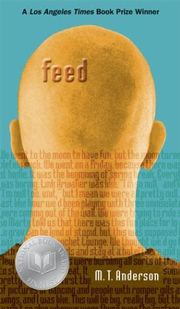
Feed, by M. T. Anderson

This audiobook was obtained as a free download from Overdrive Audio through the Alachua County Public Library. It was 5 hours and 1 minute long, and was narrated by David Aaron Baker.

A kind of technopunk novel set in what seems to be the mid to late 21st century. I may have missed a time reference. All the kids have had live feed installed from an early age. Now you can Instant Message each other, get updates, surf the net, and even watch network programming in your head. No one has to be smart anymore, because you can look up everything right now, wherever you are. So now we are all smart! And networked, and exploited by a continual stream of advertising to let you know you can also order anything you want, right now, from inside your head.

The most powerful thing about this book is not the concept, but the way the author makes it all so real. The kids are all high school age, going to privatized schools, and getting "malfunctioned" by going to game sites that quite literally blow their minds. Except for one girl, Violet, whose parents had home-schooled her and acquiesced to having her feed installed later in her childhood. Violet's awareness of a life beyond the feed makes her especially enticing to Titus, a boy who is caught up in the consumer culture of mindlessness. She likes real experiences, instead of the bizarre fads that overwhelm kids on an almost daily basis, now that it can be done so quickly.

If you can get past the fairly regular barrage of F-bombs, this is a very well-written and disturbing book. It all seems so possible in our own lifetimes. The dialog is an especially eerie feature. The adults talk like the kids today ("Dude, that was, like, awesome!") and the kids have a new jargon in which all sentences are punctuated by calling each other, "Unit!" No, it's just the boys that do that. And the girls are all hung up on a show called, "Oh! Wow! Thing!"

This is part tech satire, part sad love story, and it is especially engaging as an audiobook, where you can experience the Feed as it periodically bursts into the narration. This is a solid 3 star book with gusts of 4.

Tuesday, November 27, 2007

Higher, by Neal Bascomb

This audiobook was obtained for free from NetLibrary.com, was 11 hours and 10 minutes long, and was narrated by Richard M. Davidson.

The 1920s were the perfect time for egos, ambition, idealism, and innovation to thrive. And it was at the very apex of the Roaring 20s, just before the collapse of the stock market, that the modern skyscraper began to flower.

This story is about the men who designed, financed, and built the tallest buildings in the world at the dawn of the Great Depression. Walter Chrysler, the newly minted automobile magnate, was an engineering junkie who played an active roll in designing the Chrysler Building. The architect, William Van Alen, was a highly regarded designer who had acrimoniously split with his business partner, H. Craig Severance. Severance was now building a competing project at 40 Wall Street, and both men were determined to build the tallest building in the world.

This is a more interesting book for all the background on the creation of the technology that allowed buildings to go from the load-bearing masonry construction that limited height, to the steel-cage design, high speed elevators, and improved hydraulics that make it possible to both build and inhabit skyscrapers.

But it's the human story with its attendant drama that takes "Higher" to another level. All of the parties who were involved in these projects had come from humble beginnings, and these buildings were also intended to be monuments to ideas and hope; something that we would do well to grasp in our cynical age. This is a 4 star book.

Saturday, November 24, 2007

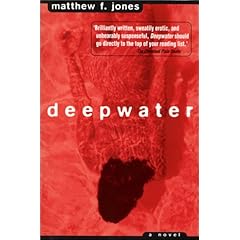
Deepwater, by Matthew F. Jones

This audiobook was obtained for free from NetLibrary.com, was narrated by Richard Ferrone, and was 9 hours and 8 minutes long.

A very weird and creepy book. Nat Banyon is a handsome drifter who works well with his hands. He meets an old man on the road named Herman Finch, and Finch hires him to do some painting at his motel. Herman is an ex-prizefighter who is married to a beautiful young woman named Iris who came to him as a traveler in need of some work three years earlier.

You don't need a PhD in literature to know that Nat and Iris are going to have a lurid affair. But this book could stand to have some sort of audio subtitles to warn you of all the dream sequences: "The following is happening in Nat's head..." And the evil possibilities begin to multiply as Nat gets tidbits of odd information about the boyfriend that Iris didn't tell him about, who arrived with her, but then disappeared. A waitress at the motel restaurant thinks he's at the bottom of the lake.

Is Herman a killer? Will Nat and Iris be discovered? Will they get away with all of Herman's loot? Will Herman kill Nat first in a boxing match he has scheduled with the younger man? The questions do not stop here, and it all ground to a halt at a fairly unsatisfying ending.

I had a love-hate relationship with this book, pretty much the way Nat was conflicted between seeing Herman as a rival and as a father figure. The characters were really good in the way they got in your head, but the story had too much foggy weirdness and an ending that did not deliver. I have to give it 2 stars.

Friday, November 23, 2007

Suite Francaise, by Irene Nemirovsky

This audiobook was obtained as a free download from Overdrive Audio through the Alachua County Public Library. It was 13 hours and 13 minutes long, and came in two parts, the first read by Daniel Oreskes, and the other by Barbara Rosenblat.

This book is actually two novellas that were part of a planned set of five. They were written contemporaneously during and about the German occupation of France. The author, Irene Nemirovsky, died in Auschwitz after being deported as a stateless person of Jewish origin.

The first novella, "Storm in June", is about the fear and dread of the German invasion. The men of fighting age are all gone. Businesses are relocating on the fly. Carloads of possessions pass desperate refugees as they head for safer ground. Whole towns are stripped of their food as the hordes pass through. For these people, the war is a huge disappointment after defeating Germany in 1918. The veterans of that war feel as if their sacrifice was for nothing. The surrender of France is a relief, just to stop the bombs and the fear of death.

The second, "Dolce", deals with the effects on the citizens of the occupation. Wealthy families host German officers, some with more grace than others. Young women, coming of age when all the young men are Germans, weigh their natural feelings against the possibility that these young men may have killed or imprisoned their fathers and brothers.

As much as it's a tragedy that the rest of this work was never finished, it is also the height of irony that such a beautifully written account was halted by the author's date with the Holocaust. And it's also a revealing look at a part of history that does not get much coverage: the lives of invaders and collaborators, when all the French had was the Passive Resistance.

I wanted it to go on. It is sad that it could not. 4 stars.

Tuesday, November 20, 2007

The No Asshole Rule, by Robert I. Sutton, PhD

This audiobook was provided by Overdrive Audio through the Alachua County Public Library. It was 2 hours and 59 minutes long, and was narrated by the author.

I will probably get emails from people whose Victorian sensibilities are offended that I would even review this book. I probably would not have even thought of getting it except that the author was interviewed on a podcast recently, and I found it intriguing.

A-word aside, this book is written like some real scholarship went into it. And even if you are uncomfortable with using that word, you probably have thought it when certain people come to mind. That is because it is a convenient one-word definition of the people who are rude and abusive, particularly of people who are less powerful. I have known a couple of pastors who fit this description. And they would probably miss the point that their behavior is the real issue, and not just the rude word I imagine when I think of them. That sort of obtuseness is part and parcel of the malady that afflicts not only themselves, but others.

This book is very thought provoking and engaging. It may also be the perfect anonymous Christmas gift. 4 stars.

The Strong, Silent Type, by C. Kelly Robinson

This audiobook was obtained free from NetLibrary.com, was 11 hours and 28 minutes long, and was narrated by Ezra Knight and Lizzie Cooper Davis.

Deacon Davis is a former Pittsburgh Steeler and son of a late, great civil right leader. He is politically active as an organizer and speech writer, but he is also a stutterer. After a particularly bad performance on a TV interview, the organization he has been working for gives him the pink slip, and he is persuaded to take part in a speech therapy experiment that will take several weeks of intensive rehabilitation at a college facility.

Davis' life is already pretty complicated. He has a daughter by one woman who is the daughter of a crime syndicate kingpin. He has a son by another woman. That boy is 13 and in trouble at school for groping a female classmate. He also has a black sheep brother who has had cocaine issues. He is still investigating their father's death and is the last person on earth who still thinks it was murder. Add to this the speech therapist that Deacon has a sexual relationship with during his rehab, and this turns into a pretty depressing stereotype festival.

As a voyeuristic soap opera, it's worth 2 stars if you like that kind of thing.

Sunday, November 18, 2007

Zugzwang, by Ronan Bennett

This novel was a free download from Overdrive Audio through the Alachua County Public Library. It was 8 hours and 28 minutes long, and was narrated by Stephen Lang.

A real chess geek would recognize the term, zugzwang, but the general public would have to run to a dictionary. In chess, it is a position in which you are compelled to move, but that doing so leads to your loss. When you have no good moves, and you wish you could pass, that is zugzwang.

And that is the metaphor for this book, set in 1914 in St. Petersburg, Russia. Revolution is afoot, and there is a big chess tournament in town. The greatest players in the world are on hand, and one of them needs professional help. Rozental is a brilliant player, but he is socially challenged and schizophrenic. An admirer named Kopelzon, a great violinist, takes Rozental to his friend, Otto Spethmann, a psychiatrist and our protagonist. All three men are Jews in a time when Jewishness is a handicap.

As if Rozental does not have enough problems, he is also being used as an unwitting pawn in a plot to assassinate Czar Nicolas, who will be honoring the winner. There are enough twists and odd characters in this story to keep your mind busy, and it is a story that is well told, for the most part. What makes this especially interesting to the chess geek is that Rozental is a thinly veiled version of Akiba Rubenstein, a chess master of the era who was a certifiable nut case. The tournament is real, and the plot is foiled; the better to preserve Czar Nicolas' date with destiny in 1918.

Spethmann works to uncover the source of Rozental's mental illness, as well as the plot that involves his patient, his friend, and his daughter, who has been sleeping with Bolsheviks. There is a lot going on here, including Spethmann's affair with the daughter of a powerful political leader, and a little gratuitous sex that seems out of place for the story. Nonetheless, this gets 3 stars, and even a non-chess player could enjoy it.